

The Great Elasmosaur Find
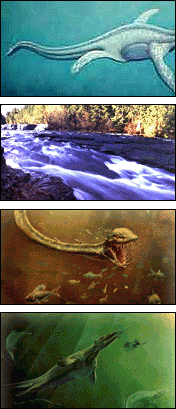 The winter of 1988 was a season of new beginnings for palaeontology in the scenic Comox Valley. Even though professional palaeontologists and geologists had surveyed Vancouver Island many times throughout the past 125 years, it was the efforts of two local amateurs that would bring the region to the attention of the world.
In late November of that year, Mike Trask and his 12-year-old daughter Heather were prospecting for fossils along the Puntledge River just west of the city. Mike was advancing in the lead, kneeling every few meters to examine a particular fossil and to mark it with chalk, for later extraction by Heather following close behind.
Suddenly, as she examined a fossil that her father had just outlined, Heather noticed a group of concretions rising from the exposed shale less than a meter away. Upon further excavation, both she and Mike were astonished to discover a group of fossilized bones from some great beast, as-yet unknown and extinct since the end of the Age of Dinosaurs.
After months of investigation and correspondence with scientists such as the late Dr. Betsy Nicholls at the Royal Tyrrell Museum in southern Alberta, their discovery proved to be the first Elasmosaur recorded in British Columbia — the first of its kind west of the Canadian Rockies.
At the heart of the subsequent activity around this discovery, was the Courtenay & District Museum, up till then a small community museum. Within a year of the marine reptile’s discovery, the museum worked with the province of BC to make the Elasmosaur location a provincial heritage site, and set about to excavate the rest of the animal with staff and numerous volunteers. Dr. Rolf Ludvigsen led the excavation. Since then, the public has expressed a growing curiosity in this science in general, and in the other large extinct reptiles that have been discovered, including a tylosaurus.
Today, the museum stands at the forefront of the exploration of more than 400 million years of prehistory on Vancouver Island. Numerous programs and projects continue to encourage and support the amateur earth scientist in all of us.